

Welcome to our last Newsletter and Case Update for 2025, where we aim to keep you up to date with all that is happening in the law affecting workplaces, and with what we have been doing here at KJK Legal.
Firm News
Save the Date – KJK Legal’s February 2026 Summer Workplace seminar
Our team has been busily finalising details for our next seminar being held on Wednesday, 4 February 2026 at the Majestic Roof Garden Hotel.
Details will be provided early in the new year so keep an eye on your Inbox for additional information!
KJK Legal to celebrate 15 years of business in 2026
How quickly time flies when we’re having fun as we also work!
It’s hard to believe that KJK Legal will be celebrating 15 years of business in 2026, particularly when celebrating our 10th year in 2021 only feels like yesterday.
We thought this occasion would be a great time to change things up for 2026 – increase our social media presence, look to refresh our brand, reinvigorate our website, and a host of other subtle changes in the pipeline.
Of course, with this comes the opportunity to hear from you – our clients and contacts – we’d love to hear what you think we do well, where we can improve, what you’d like to see more (or less) of, and anything else that you think may be of relevance. We greatly value input from our clients and contacts – please contact Amanda Atkins or telephone +61 8 7324 7800 to discuss any suggestions you may have.
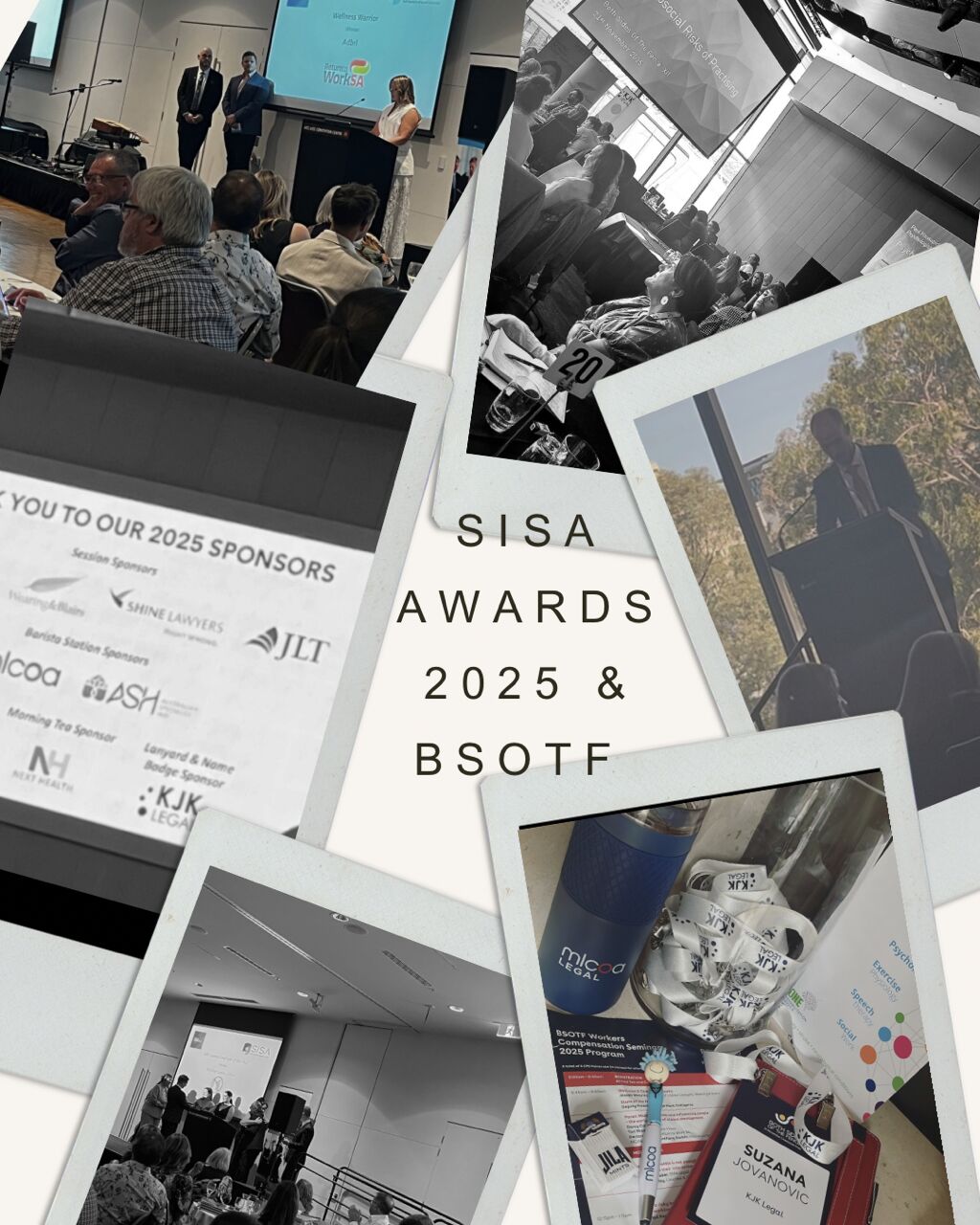
SISA Awards 2025
Our team attended the SISA Awards 2025 dinner last month. It was inspiring to celebrate outstanding achievements in workplace health, safety and injury management with our dedicated clients and fellow colleagues. Hearing stories from the award winners was a true highlight. Congratulations to all the winners and nominees for their great work in advancing workplace safety in South Australia. We look forward to attending next year!
Sponsorships
Both Sides of the Fence 2025
KJK Legal was honoured to serve as the official lanyard and name badge sponsor at this year’s Both Sides of the Fence Conference. Supporting such a key event in workers compensation law reflects our ongoing commitment to the profession and our valued network.
As always, the all day CPD event offered a fantastic platform for learning, networking, and engaging with others in our field of work including solicitors, barristers, clients and medical providers such as MLCOA, ASH and One Rehabilitation Service who were also some of the sponsors this year.
The event brought together leading minds in workers compensation law for dynamic panel discussions and insightful presentations, including a session on managing psychological risks led by Mr Paul Kassapidis (Psychologist). Mr Sean Richter (Barrister at 3 Shell Chambers) did a ‘deep dive’ into the Harman principle, social media and surveillance. Our Tracey Kerrigan, who is on the committee, was also a moderator for one of the panel discussions which related to tying off loose ends after an in principle settlement has been reached.
We join DPJ Calligeros in acknowledging DPJ Gilchrist’s dedication and leadership over his 31 years of distinguished judicial service and wish him all the best in his retirement.
Workplace Health and Safety update
Why SA’s New Defibrillator Laws Matter for Workplace Safety
An Automated External Defibrillator (AED) is a life-saving device that can restore a normal heart rhythm during a sudden cardiac arrest. In an emergency, immediate CPR and defibrillation dramatically increases chances of survival. That makes AEDs (and ready access to them) a critical part of any organisation’s WHS/first-aid planning. With new requirements under the Automated External Defibrillators (Public Access) Act 2022, more workplaces and public facilities in South Australia will now need to include AEDs as part of their safety infrastructure, making AED readiness a legal duty, not just a “good to have.”
What the new legislation requires
Under the Act, “designated buildings/facilities” (e.g., public-access buildings, sporting/recreation venues, schools, aged-care, caravan parks, community centres, theatres, etc.) or “prescribed buildings” (e.g., commercial offices or other commercial-land buildings with certain floor space) must have AEDs installed.
For “non-Crown” buildings and facilities, the legislative compliance date is 1 January 2026.
WHS Advice: What Building Owners and Employers should do now
If you manage or own any facility in South Australia that is in the scope of the legislation, we recommend the following to ensure that you are in compliance with the new laws, on top of making your environment safer.
- Carry out a compliance assessment: Determine if your building or facility (or vehicle fleet) is covered under the Act (public-access, commercial land, floor area, building type).
- Calculate how many AEDs are needed: At least one AED per building, and additional AEDs depending on publicly accessible floor area (generally one per 1,200m²).
- Purchase compliant AED(s): Ensure devices meet regulatory approval (TGA-approved) and are suitable for your environment (indoor, outdoor, business, public access, etcetera).
- Plan installation locations: Pick visible, accessible, logical spots (e.g., near main entrances, central hallways, reception or common areas) and avoid locked cupboards or restricted-access cabinets where delay could be dangerous.
- Install clear signage: Mark entrances and AED locations so even a bystander unfamiliar with the building can find the AED quickly in an emergency.
- Register AEDs promptly with SA Ambulance Service as required by legislation.
- Implement maintenance and review procedures: Schedule regular checks (battery, pads, device integrity), track expiry dates, and ensure replacement or servicing as needed, update registration if AED location or access changes.
- Include AEDs in your workplace emergency response plan: Make sure staff know where the AED is, how to access it, and basic response procedures (calling emergency services, CPR, AED retrieval).
Why this matters from a WHS perspective
Legal compliance and liability: Because AED installation is now law in many public/commercial buildings in SA, failure to comply may expose building owners/operators to legal penalties and workplace safety liability.
A proactive safety culture: Installing AEDs is not only ticking a compliance box but also it’s an investment in safety culture, emergency readiness, and community wellbeing.
Recent Decisions of the South Australian Employment Tribunal
Hamilton v Return to Work Corporation of South Australia & Victoria Hotel Port MacDonnell [2025] SAET 111
Topic: Noise induced hearing loss / costs
Commentator: Tracey Kerrigan
Background
The worker pursued a claim for noise induced hearing loss which was accepted by the respondent. A permanent impairment assessment was undertaken by Dr Hunter which assessed the worker at 4% WPI. Dr Hunter gave no allocation for tinnitus on the basis that the worker’s complaints were not severe. A nil PIA determination was issued and the worker filed an Application for Review challenging the decision and Dr Hunter’s assessment.
The issue as to tinnitus revolved around whether Dr Hunter had taken account of two certificates from the GP which were not mentioned in the original assessment. Dr Hunter subsequently clarified that he had received and taken account of the certificates at the time of the assessment.
The matter had proceeded through conciliation and been referred to hearing and determination. It would appear that the worker then gave instructions to concede the dispute on the basis that RTWSA paid her reasonable costs. Orders were made to confirm the decision but with the question of costs reserved. RTWSA made an application that the worker not receive an order for costs in her favour and also sought an order for costs against her in light of the Full Court decision in Sweeney based on an asserted offer of compromise put at conciliation.
Issues
- Whether a costs order should be made in favour of or against the applicant?
- Whether in the absence of the issues proceeding to trial the judge should rely on the approach taken in Sweeney?
- Whether an asserted offer of compromise expressed in light of the principles under Calderbank applied in terms of the costs orders being sought by both parties?
Held
The judge was satisfied that the worker did not act unreasonably in pursuing the dispute initially and was not adopting a frivolous and vexatious approach to litigation.
As the matter had not proceeded to a hearing, the approach as to costs under section 106(7) adopted in Sweeney did not apply. It was arguable initially that Dr Hunter had not properly considered the tinnitus issue and it was proper for a clarifying report to be obtained. It was appropriate to seek a clarifying report and the worker had then acted reasonably in agreeing to orders dismissing her application for review. Giving consent to such orders was not an admission by the worker that her case was without merit.
Key Takeaway
Although it is easier now following Sweeney for a compensating authority to argue that a worker should not receive their costs of a dispute, it is still difficult to persuade the Tribunal to make an order depriving a worker of their costs or making an adverse order against a worker where they take reasonable steps to clarify PIA reports and then act appropriately when the clarifying report is received (even if the clarification does not ultimately assist them).
A link to the full text of the case can be found here.
Walker v Return to Work Corporation of South Australia [2025] SAET 113
Topic: Case summary – A worker’s non-compliance in the Tribunal
Commentator: Lauren Knappstein
Background
The worker was a Patient Services Assistant at the Royal Adelaide Hospital who submitted a claim for Pericarditis and PTSD allegedly caused by the mandatory 3rd COVID-19 vaccination administered on 1 April 2021.
Return to Work SA (RTWSA), in attempt to investigate the claim, arranged several medical examinations including psychiatry, cardiology and haematology, but the applicant had only attended one despite repeat attempts given for each.
RTWSA therefore rejected the claim, because the applicant simply failed/refused to attend the medical examinations that were arranged. After lodging an Application for Review, the applicant was uncontactable by the commissioner, the applicant’s lawyers ceased to act due to no instructions, and the applicant repeatedly failed to comply with directions to file tribunal documents. After a strike out hearing was listed, there was no appearance on behalf of the applicant and therefore no submissions were made.
Issues
- Should the Application for Review be struck out on either of the following grounds:
- want of prosecution under section 40(4); and/or
- failure to comply with directions or attend hearings under section 42.
- Has the respondent shown disadvantage caused by the applicant’s actions to a degree that dismissal is justified?
Held
The Tribunal found that there was a clear failure to prosecute the review application, and that the respondent had suffered a disadvantage. It was also found that there was no medical evidence supporting the applicant’s claim, and the claim misused Tribunal resources.
On that basis, the Tribunal struck out the Application for Review and dismissed the proceedings.
Key Takeaway
RTWSA and self-insurers can successfully obtain dismissal where a worker repeatedly fails to attend medical appointments or comply with Tribunal directions, provided the respondent clearly documents the non-compliance and resulting prejudice.
A link to the full text of the case can be found here.
Miller v The State of South Australia & Ors [2025] SAET 119
Topic: Dust disease, malignant peritoneal mesothelioma, assessment of damages, contribution
Commentator: Oliver Fragnito
Background
The Applicant, Mr Miller, has malignant peritoneal mesothelioma and claims he was exposed to asbestos when working as an employee, in operating his own business and in performing renovations on a former family home.
Mr Miller sought damages from the State of South Australia (the State) for exposure during a six month period in 1991 when he worked at the Royal Adelaide Hospital (RAH) whilst employed by a now defunct labour hire company (Manpower). Mr Miller also sought damages from Amaca Pty Ltd formerly James Hardie and Coy Pty Ltd (Amaca), a company that manufactured products that contained asbestos.
Held
To prove causation, Mr Miller had to establish that his injuries were “caused or materially contributed” by his exposure to asbestos at the RAH and from Amaca products. The work performed by Mr Miller at the RAH disturbed clumps of blue asbestos that had fallen from structural steel beams and had landed in various places, including on the upper side of ceiling tiles, into risers and onto extruded objects in risers and onto the floor of the catacombs. The court accepted that Mr Miller’s exposure to asbestos at the RAH was materially greater than the everyday level of exposure to asbestos fibres than most people have. The Judge accepted that Mr Miller was able to prove the State and Amaca caused him injury, loss and damage, owed him a duty of care and they breached that duty of care.
The decision explored the comparison of what has been awarded in similar cases interstate especially regarding non-economic loss. The most notable decision of recent years and a comparable decision in this space is Werfel where an award of $280,000.00 was made for non-economic loss and $2,228,478.00 overall. It was accepted that the cost of living has increased substantially since then and this should be taken into consideration when making an assessment.
The Judge accepted the evidence of one of the experts that a death caused by peritoneal mesothelioma takes longer, and is even more painful and unpleasant, than a death caused by pleural mesothelioma and the unwelcome task to estimate how long someone who is suffering from a horrible illness will survive. The Judge assessed past non-economic loss at $230,000.00 and future non-economic loss at $170,000.00, the award being greater than the award in Werfel and this is warranted due to the cost of living increase since those decisions.
Furthermore, Mr Miller was able to successfully establish a claim for exemplary damages, something we do not see often in South Australia. Overall, the Judge determined that Mr Miller was entitled to damages totalling $2,210,824.20. A large proportion of this related to economic loss as Mr Miller was still working and running his own electrical business when diagnosed.
It was accepted that the State assumed greater responsibility for Mr Miller’s injury loss and damage than Amaca. The trial explored the risk ratios and found the State liable for 80% of damages and Amaca held 20%.
The State sought contribution from Bradford Insulation (BI) on the basis it manufactured and installed all the sprayed insulation used in the RAH building which were constructed in 1959, 1960s and 1970s. This was not denied and it was determined that the State is entitled to contribution from BI equivalent to 40% because it failed to issue any warning about the danger of the product it sprayed namely crocidolite at the RAH, but the State’s conduct is culpable because it became aware of the danger of sprayed crocidolite at least 11 years prior to Mr Miller working at the RAH but failed to warn him of that danger or provide him with a mask and direct him to wear a mask whilst working. As the RAH could have used inexpensive and easily implemented measures to reduce risk the State should bear more responsibility than BI.
Key Takeaway
There has been a significant increase in damages being awarded in the dust disease/toxic tort space although one could say that this was partly due to the condition suffered which is more painful and longer lasting than other types of mesothelioma.
Is South Australia getting closer to those in the Eastern States? Yes, but inevitably assessments of damages will remain traditionally lower than our Eastern counterparts. This will have a direct assessment on quantum assessments and plaintiff formulations. Contributions from suppliers is something that is available but the employer’s conduct particularly for later exposure is increasing.
A link to the full text of the case can be found here.
High Court of Australia Decision
Elisha v Vision Australia [2024] HCA 50
Topic: The importance of having good policies in place and follow them
Commentator: Claire Eagle
Background
Whilst not a new decision, it is timely to ensure that policies and procedures are being followed even when there are shut downs, social events and work related travel increasing the possibility of injuries and claims.
Facts
Adam Elisha (Elisha) began employment with Vision Australia Ltd in September 2006 as an adaptive‑technology consultant, under an employment contract.
In March 2015, while staying at a hotel on a work trip, Elisha was involved in an incident (allegedly aggressive/intimidating behaviour towards the hotel proprietor).
In May 2015, Vision Australia issued a “stand‑down” letter to Elisha requiring him to attend a disciplinary meeting regarding the hotel incident. The letter referred to Vision Australia’s disciplinary procedure.
At the disciplinary meeting, Elisha denied the allegations. Internally, Vision Australia held other alleged “pattern” or prior behaviours against him (which had not been included in the stand‑down letter or put to him at the meeting).
On 29 May 2015 his employment was terminated for serious misconduct. After termination, Elisha was diagnosed with major depressive disorder and an adjustment disorder with depressed mood. He claimed he had no work capacity for the foreseeable future.
Claims
Elisha brought proceedings in the Supreme Court of Victoria in August 2020 alleging:
- Breach of contract – that Vision Australia breached the disciplinary procedures that were incorporated into his employment contract (i.e., failing to follow the company’s own process).
- Negligence — that Vision Australia owed a duty of care in conducting the disciplinary and dismissal process and breached it leading to his psychiatric injury.
The Trial Judge found Vision Australia had breached the contract (because the disciplinary procedure was incorporated) and awarded damages for psychiatric injury. The Court of Appeal overturned part of that decision (holding psychiatric injury was not recoverable in that contract context under the precedent).
The High Court of Australia handed down its judgment on 11 December 2024 and held that Elisha’s contract incorporated Vision Australia’s disciplinary procedure and policies because the contract referenced compliance with the company’s “Policies and Procedures” and stated that breach might lead to disciplinary action. That is, because the disciplinary procedure was a contractual term, Vision Australia was bound by it. The Court found Vision Australia breached the disciplinary procedure when it did not put to Elisha any allegations regarding earlier behaviour that they relied upon in the termination.
The High Court reinstated the trial judge’s award of approximately $1.44 million in damages to Elisha for his psychiatric injury from the breach of contract.
Significance and Implications
This case marks a major shift in Australian employment law by opening a pathway for employees to claim damages for psychiatric injury resulting from a breach of employment contract terms.
For employers:
- Policies and procedures may become contractual terms if the employment contract refers to them. If so, failing to follow them can constitute a breach of contract with potentially serious liability.
- The termination/disciplinary process must comply strictly with procedural commitments (e.g., allegations must be fully put, the employee must have a real chance to respond, and relevant evidence must be communicated).
Key Takeaways
Policies matter and the way they are applied matters too.
Process must be followed: disciplinary action and termination of employment should be conducted strictly according to the policies, especially if they are referenced in employment contracts.
Employers should take regular and considered preventive action by considering and amending your employment contracts. You should check what policies are incorporated, revise or clarify procedural provisions and ensure actual practice mirrors contractual commitments at all levels.
A link to the full text of the case can be found here.
Federal Court of Australia Decision
Fair Work Ombudsman v Woolworths Group Limited [2025] FCA 1092
Topic: Pitfalls of paying “Above the Award”
Commentator: Claire Eagle
Background
The Fair Work Ombudsman (FWO) brought proceedings against Woolworths (and similarly Coles) alleging widespread underpayments of salaried employees who were covered by the General Retail Industry Award 2010 (GRIA) and the Fair Work Act 2009 (FWA).
The core issue was that employees on annualised salary (or “all-in” salary) were paid a fixed salary rather than being paid overtime, penalty rates, allowances etcetera based on hours worked. Employers used contractual “set-off” or “offset” clauses in employment contracts to say that the salary covered those Award entitlements.
Woolworths had previously admitted to underpayments and had undertaken remediation (in excess of $300 million in repayments) but the FWO alleged that the remediation was insufficient.
Key Findings
Justice Perram found that the contractual set-off clauses relied upon by Woolworths (and Coles) could not lawfully allow over-payments in one pay period to offset under-payments in another. The entitlement under the Award must be satisfied within each pay period.
Annualised salary arrangements do not relieve detailed record-keeping obligations, implying that “efficiency” was in fact dereliction of the responsibility to pay staff properly according to the relevant industrial instrument. Records must also be in a form that is readily accessible to an inspector or an employee.
Contract drafting and employee agreements must be scrutinised. The Court looked closely at how the set-off clauses were drafted. For Woolworths, the clause allowed satisfaction “over a 26-week period” which was held not to be compliant.
Implications
Employers who pay salaried employees (especially those covered by Awards) and rely on annualised salary or broad set-off clauses must review their arrangements.
Payroll systems, timesheets, records of hours worked, overtime, allowances must be robust and able to ensure compliance on a pay-period basis.
A link to the full text of the case can be found here.
As always, should you have any queries, feedback or comments on anything we have discussed above, or advice on any workplace legal needs, then please do not hesitate to reach out to one of us.
If you wish to undertake further reading in relation to any of the decisions discussed above, they can be found at AustLII (SAET decisions), AustLII (High Court of Australia decisions), and the Federal Court of Australia.
